



Expanding our ZIGsight into freshwater ecology
USGS and collaborators recently published new global, harmonized collection of freshwater zooplankton records
USGS and collaborators recently published new global, harmonized collection of freshwater zooplankton records
As above, so below?
New USGS study examines trends in groundwater and streamflow across the United States 1980-2020
New USGS study examines trends in groundwater and streamflow across the United States 1980-2020
From Source to Streams
New national models estimate seasonal nutrients over 21 years in rivers across the U.S.
New national models estimate seasonal nutrients over 21 years in rivers across the U.S.
New Research, Development, and Innovation Program
The Hydrologic Instrumentation Facility (HIF) launches national research and development program
The Hydrologic Instrumentation Facility (HIF) launches national research and development program
Water Resources Mission Area
Water information is fundamental to national and local economic well-being, protection of life and property, and effective management of the Nation’s water resources. The USGS works with partners to monitor, assess, conduct targeted research, and deliver information on a wide range of water resources and conditions including streamflow, groundwater, water quality, and water use and availability.
Message from the Associate Director
Message from the Associate Director

Learn more about the Mission Area from the Associate Director for Water Resources.
Water Data for the Nation
Water Data for the Nation

Water data collected at approximately 1.9 million sites across all 50 states.
News
Science Spotlight: USGS Monitoring of Glacial Outburst Flood in Juneau Alaska
Science Spotlight: USGS Monitoring of Glacial Outburst Flood in Juneau Alaska
Expanding Our Global ZIGsight into Freshwater Ecology
Expanding Our Global ZIGsight into Freshwater Ecology
As above, so below? Trends in groundwater and streamflow across the United States 1980-2020
As above, so below? Trends in groundwater and streamflow across the United States 1980-2020
Publications
A roadmap for identifying and interpreting physical processes and national water model prediction bias associated with baseflow index regimes across the contiguous United States A roadmap for identifying and interpreting physical processes and national water model prediction bias associated with baseflow index regimes across the contiguous United States
Understanding how groundwater–surface water interactions shape streamflow variability is critical for diagnosing low flow behavior and prediction bias in continental scale hydrologic models. We present a process informed framework that links observed baseflow (BF) dynamics, watershed attributes, and National Water Model (NWM) performance across the contiguous United States. Using daily...
Triple oxygen isotope compositions of isotopic reference waters: Implications for VSMOW-Scale and VSMOW-SLAP-Scale Δ′¹⁷O calibration Triple oxygen isotope compositions of isotopic reference waters: Implications for VSMOW-Scale and VSMOW-SLAP-Scale Δ′¹⁷O calibration
Triple oxygen isotope ratios of waters are commonly reported on the VSMOW–SLAP scale, whereas comparison with theoretical calculations and assessment of instrumental scale distortion require accurate constraints on the measured isotopic compositions of the primary isotopic reference materials (iRMs) themselves. In particular, the measured δ17OVSMOW and Δ′17OVSMOW values for SLAP and its...
U.S. Geological Survey Monitoring Milestones—Oe-151 at Woodgate, NY (433112075091501) U.S. Geological Survey Monitoring Milestones—Oe-151 at Woodgate, NY (433112075091501)
On July 9, 1926, monitoring well Oe-151 at Woodgate, New York (USGS ID 433112075091501) recorded its first groundwater data. Since then, the well has provided water data nearly continuously and has now reached a 100-year milestone for data collection. The well is part of the U.S. Geological Survey (USGS) Climate Response Network (CRN), which is a national network of wells selected to...
Science
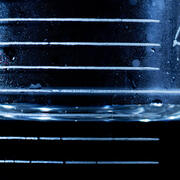
Water Meniscus
A meniscus is a curve in the surface of a molecular substance (water, of course) when it touches another material. With water, you can think of it as when water sticks to the inside of a glass.

Temperature and Water
Water temperature plays an important role in almost all USGS water science. Water temperature exerts a major influence on biological activity and growth, has an effect on water chemistry, can influence water quantity measurements, and governs the kinds of organisms that live in water bodies.

Vapor Pressure and Water
The vapor pressure of a liquid is the point at which equilibrium pressure is reached, in a closed container, between molecules leaving the liquid and going into the gaseous phase and molecules leaving the gaseous phase and entering the liquid phase. To learn more about the details, keep reading!